Every Arabic name carries a story, an intention, and a linguistic heritage. Far from being simple labels, Arabic names draw their strength from a language where every word has a transparent meaning. To understand their origins, their rules, and their aesthetic dimension is to access an entire facet of Arabic and Islamic culture. From pre-Islamic roots to contemporary uses, including the recommendations of prophetic tradition, this overview aims to decode what makes Arabic names so rich and their deep connection with personalized calligraphy.
A language where every name has a meaning
The Arabic language has a remarkable feature: it does not draw a sharp line between common nouns and proper names. Every given name is first and foremost a word from everyday vocabulary, carrying an explicit meaning. This semantic transparency gives the choice of a name a significance that other linguistic traditions do not share.
The male name Salīm (سليم), for example, means "sound, safe, in good health." This is not some buried etymology: an Arabic speaker instantly perceives the meaning of the word. Likewise, Jamīla means "beautiful," Karīm "generous," and Nūr "light." The name functions as a wish spoken aloud.
This readability of meaning explains why, in Muslim culture, choosing a name is of particular importance. Tradition considers it an emblem by which a person will be called in this world and the hereafter. Naming a child means giving them a meaningful identity—a life purpose condensed into a few syllables.
Origins and historical layers of Arabic names
Arabic names do not form a monolithic block. They have been built up through successive layers, reflecting the cultural exchanges between the Arab world and its neighbors.
Some names come from languages older than classical Arabic. Maryam, the Arabic form of Mary, derives from the Hebrew Myriam, the name of Moses' sister. This name illustrates the continuity between Abrahamic traditions and the way Arabic integrated names from the common Semitic root.
Pre-Islamic Arabia had its own conventions, which were sometimes surprising. Children were often given names with harsh or negative sounds: Ḥarb ("war"), Murra ("bitterness"), or Ḥazn ("sorrow"), in the hope of warding off bad luck. This practice was based on the belief that a rough name protected its bearer from malicious spirits.
The advent of Islam deeply transformed these customs. Prophetic tradition encouraged names with positive meanings and discouraged those with unfavorable connotations. This shift reshaped the Arabic name pool within a few generations.
Arabic names and Islamic tradition: recommendations and prohibitions
Islamic tradition gives names a spiritual dimension that goes beyond simple social convention. Several principles guide the choice of a name from this perspective.
The most recommended names
A ḥadīth reports that the names most loved by God are ʿAbd Allāh ("servant of God") and ʿAbd al-Raḥmān ("servant of the Most Merciful"). The structure ʿAbd followed by a divine name or attribute (meaning "servant of...") is found in many Arabic names. It expresses a bond of devotion and humility toward the Creator.
The names of prophetic figures and their close companions also hold a prime position. Muḥammad, which means "praiseworthy," is today the most widespread name in the world, borne by over 130 million people according to some estimates.
Discouraged or forbidden names
Tradition condemns several categories of names. It is forbidden to bear a name implying servitude to anyone other than God, such as ʿAbd al-ʿUzzā ("servant of the goddess al-ʿUzzā"). Similarly, claiming a name or title that belongs exclusively to God, like al-Raḥmān ("the Most Merciful") or "King of Kings," is prohibited, as tradition states that "there is no King but Allah."
Names with explicitly negative meanings, like Ḥarb ("war") or Ḥazn ("sorrow"), are also discouraged. Tradition records that the Prophet of Islam occasionally renamed individuals whose names carried unfavorable connotations. For instance, he changed the name of a woman called ʿĀṣiya ("disobedient") to Jamīla ("beautiful"), and that of a man named Ḥazn ("rough, sorrowful") to Sahl ("gentle, easy").
When prestige outshines the original meaning
The link between a name and its literal meaning can sometimes take a paradoxical turn. Certain names with neutral or even unflattering etymologies have become some of the most widely used in the Muslim world, thanks to the prestige of their historical figures.
Khādija literally means "born prematurely." Fāṭima translates to "she who weans her child." These modest, original meanings faded away behind the deep reverence for the first wife and the daughter of the Prophet of Islam. The name no longer states what it means in the dictionary: it proclaims who bore it.
This phenomenon illustrates a dynamic unique to Arabic names. The emotional and spiritual resonance of a name can supplant its etymology. Choosing a name then becomes an act of symbolic lineage—a tribute paid to a foundational figure rather than a wish tied to the word's literal meaning.
Arabic calligraphy at the service of the name
The Arabic script shares a unique relationship with names. Where the Latin alphabet distinguishes between uppercase and lowercase, the Arabic script does not. Instead, each letter takes on different forms depending on its position in the word (initial, medial, final, or isolated), which can result in up to eighteen variations for a single character.
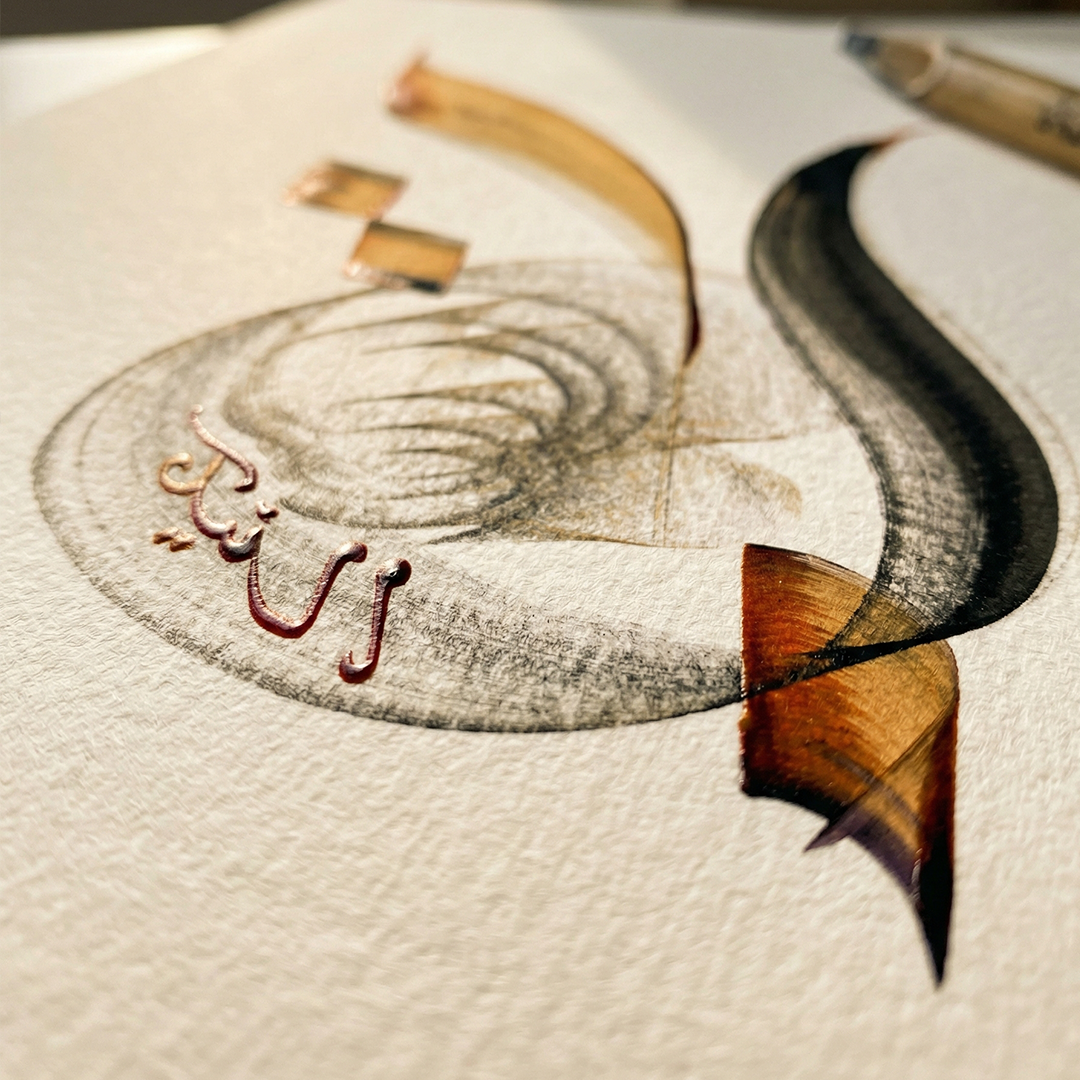
This morphological richness makes every calligraphed name a unique composition. The calligrapher does not simply transcribe: they compose, adjust proportions, and select a style. The naskh script offers crystal-clear readability, thuluth brings monumental majesty, and dīwānī provides ornamental fluidity.
The tradition of calligraphing proper names goes back centuries. In the Ottoman Empire, the ṭuġrā served as a calligraphic monogram representing the sultan. This seal contained his name and official titles, turning the ruler's identity into a work of graphic art. The name thus became a symbol of power as much as an aesthetic object.
The contemporary appeal of personalized calligraphy
The calligraphy of names is experiencing a remarkable revival today. Contemporary artists have taken to creating and sharing calligraphed versions of hundreds, sometimes over a thousand Arabic names online, meeting the growing demand from an audience passionate about this art form.
This popularity is driven by several factors. Personalized calligraphy allows people to reconnect with an artistic tradition while bringing it into everyday life. A calligraphed name can adorn a frame, a piece of jewelry, or a home decor item. It becomes an intimate object, carrying both identity and beauty.
For families in the Arabic and Muslim diaspora, having a child's name calligraphed is often a powerful act of passing down heritage. The name, chosen for its meaning and spiritual resonance, finds a visual form in calligraphy that matches its symbolic weight. Handwritten script, with its elegant variations of thick and thin strokes, restores a depth that standard digital typography simply cannot replicate.
The required technical mastery remains demanding. Writing a name in Arabic calligraphy requires a deep understanding of the different letter forms and mastering the fluid connections specific to each style. This standard ensures that every creation remains a unique piece, shaped by the hand and breath of the calligrapher.
Choosing and calligraphing an Arabic name: a meaningful act
An Arabic name sits at the crossroads of language, spirituality, and art. Choosing one involves reflecting on the meaning of words, the cultural heritage one wishes to pass down, and the beauty one wants to associate with an identity.
From the semantic transparency of Arabic to the recommendations of prophetic tradition, from pre-Islamic historical layers to the modern passion for personalized calligraphy, every step of this journey reveals the same conviction: a name is never trivial. It carries a meaning, a memory, an aspiration.
Calligraphy extends this conviction by giving it a visible form. Transforming a name into a calligraphic work of art honors both the language that forged it and the person who bears it. It also sustains an art whose vitality, far from fading, is renewed with every single name traced with the qalam.