“How is my name written in Arabic?” A name isn't translated: it's transcribed, sound by sound, with Arabic letters. And since Arabic has no p, no v and no hard g, and writes few of its vowels, the same name can be spelled in several ways, all of them correct.
Here is the method, the choices it involves, the pitfalls of automatic tools and the spelling of forty first names common in France, as found in the Arabic-language encyclopedia and press.
In brief
- Transcribe the sound, not the meaning: Pierre is written بيير or بيار, not حجر, “stone” (what pierre means in French).
- Three consonants are missing (p, v and hard g), and Arabic distinguishes only three vowels: a, i and u.
- Several spellings are correct. If your name already appears in Arabic on your official documents, keep that one.
- Some names have an Arabic equivalent: Marie (Mary) can become مريم, Maryam. It is then a different name.
Translate or transcribe?
To translate is to render the meaning of a word; to transcribe is to render its sounds with the letters of another script. A name is transcribed: that is how the Arabic-language press and encyclopedia write Paris (باريس), Kylian Mbappé (كيليان مبابي) or Emmanuel Macron (إيمانويل ماكرون). The only exception: names that have an old Arabic equivalent, such as Marie (Mary) or Joseph, which we cover below.
The Arabic alphabet in four points
- It is written from right to left. The first letter of a name is the one farthest to the right.
- Its 28 letters are consonants. Three of them, ا, و and ي, also mark the long vowels a, u and i.
- Letters join up and change shape depending on their position in the word. Six never join the letter that follows (ا د ذ ر ز و): Rose, روز, is therefore written with three letters that don't touch.
- Short vowels are not written as a rule. Small signs, the harakat, can show them: you see them in the Quran, in children's books and often in calligraphy.
French sounds such as “é”, “u” or “eu” therefore have no exact equivalent: you take the closest vowel. In fact, almost every vowel is written in a foreign name: Emma becomes إيما, with a ي for the “e”.
How to write your name in Arabic: the four-step method
- Say your name out loud and break it down into sounds, not letters: “Kevin” gives k-e-v-i-n.
- Give each consonant an Arabic letter: ك for k, ف (or ڤ) for v, ن for n.
- Write the vowels with ا, و or ي; a few short vowels can be left implied.
- Write from right to left, joining the letters, then have the result checked by someone who reads Arabic.
For Kevin, you get كيفن or كيفين, depending on whether or not you write the “i”: Arabic Wikipedia uses both, for Kévin Gameiro and for Kevin Mayer. With ڤ instead of ف, the “v” stands apart from the “f”: كيڤن.
Missing sounds and silent letters
In 1964, the journal of the Arab Academy of Damascus published an article by Mustafa al-Shihabi setting out the rules of the Academy of the Arabic Language in Cairo for writing foreign names: follow the pronunciation, leave out silent letters, and give p and v two new letters, پ and ڤ. Usage has drifted away from these rules: the press most often writes ب and ف, and each region has its own letter for the hard g. Here are the usual solutions for the sounds of French, with examples from Arabic Wikipedia.
| French sound | Letter | Examples and other options |
|---|---|---|
| p | ب | Paul Pogba, بول بوغبا. Other option: پ, the Persian letter. |
| v | ف | Jules Verne, جول فيرن. Other options: ڤ, or ڥ in Algeria and Tunisia. |
| hard g | غ or ج | Charles de Gaulle, شارل ديغول or شارل ديجول; in Egypt, ج is already pronounced “g”. Other options: ڨ in Algeria and Tunisia, ڭ in Morocco, گ in Iraq, in the Gulf and in Persian. |
| j, soft g (as in French “je”, like the s in “measure”) | ج | Jacques Chirac, جاك شيراك |
| ch (said “sh”) | ش | Charles, شارل |
| u (the French u, between “ee” and “oo”) | و or ي | Marie Curie, ماري كوري; Hugo Lloris, هيغو لوريس |
| é, è (as in “café” and “bed”) | ي | Kylian Mbappé, كيليان مبابي. At the end of a word, the French endings -é, -et, -ez and -ier often become يه: Thomas Pesquet, توما بيسكيه. |
| eu (close to the vowel in “her”) | و | Eugène Delacroix, أوجين ديلاكروا; sometimes يو, as for Gérard Depardieu, جيرارد ديبارديو. |
| oi (said “wa”) | وا | François, فرانسوا |
| an, en, ain, un (nasal vowels) | ان | François Hollande, فرانسوا أولاند |
| on (nasal vowel) | ون | Emmanuel Macron, إيمانويل ماكرون |
| gn (said “ny”, as in “canyon”) | ني | Avignon, أفنيون; but Agnès Varda, آغنيس فاردا, following the spelling. |
Usage also varies for letters that are silent in French. On Arabic Wikipedia, the s in Louis is always written (لويس), the one in Jules never (جول); Thomas Pesquet becomes توما, Thomas Lemar توماس.
At Noun Qalam, we take the Academy's side: follow the pronunciation. Zohra sums it up in the site's FAQ: she makes “a faithful phonetic adaptation”, so that your name is pronounced the way you pronounce it.
When your name has an Arabic equivalent
Many biblical names have an old Arabic form, often found in the Quran. Choosing it means changing names: مريم is pronounced “Maryam”, not “Marie” or “Mary”. For a few names, Muslim usage and Arab Christian usage differ, with no strict dividing line.
| Name | Quranic form | Arab Christian form |
|---|---|---|
| Abraham | إبراهيم Ibrahim | the same |
| Adam | آدم Adam | the same |
| David | داود Dawud | the same |
| Elijah | إلياس Ilyas | إيليا Iliya |
| Gabriel | جبريل Jibril | جبرائيل Jibrail |
| John the Baptist | يحيى Yahya | يوحنا Yuhanna |
| Jonah | يونس Yunus | يونان Yunan |
| Joseph | يوسف Yusuf | the same |
| Mary | مريم Maryam | the same |
| Michael | ميكائيل Mikail (ميكال in the text of the Quran) | ميخائيل Mikhail |
| Moses | موسى Musa | the same |
| Noah | نوح Nuh | the same |
Peter (بطرس, Butrus) and Paul (بولس, Bulus) only have a Christian form. And Arabic speakers themselves often transcribe: in Lebanon, Michel Aoun is written ميشال عون.
Why machine translators get it wrong
We tested Google Translate on November 4, 2026, from French into Arabic, typing in French first names on their own.
- Meaning instead of sound. “Rose” becomes وردة, the flower, and “Ambre” (French for amber) becomes كهرمان, the resin. “Pierre” and “Jean” are transcribed correctly, but the tool also suggests حجر, “stone” (the meaning of pierre in French), and بنطلون الجينز, “jeans” (in French, un jean is a pair of jeans).
- A spelling that changes. “Jade” on its own gives جاد, which is also the Arabic male name Jad. “Je m'appelle Jade” (“My name is Jade”) gives اسمي جيد, where جيد reads “good”.
“Name in Arabic” generators do hardly any better: the two we looked at send the name to a machine translator and display its answer in a font. On one of them, the thuluth and diwani “styles” are even fonts drawn in a different style.
At Noun Qalam, it is Zohra, not software, who adapts your name phonetically, before writing it out in ink with a qalam, the calligrapher's reed pen.
One last pitfall: software that handles Arabic poorly displays the letters unconnected and in the wrong order. It happened during the 2012 London Olympic Games, on welcome banners that had to be replaced. Before an engraving or a tattoo, have the final file checked, not just the spelling.
How are common first names written in Arabic?
Here are the spellings Arabic Wikipedia uses for well-known people with these names, noted on November 4, 2026, along with the variants we came across. All of them are in use. They follow the French pronunciation of these names, the one used by most of the people cited: said the English way, the same name may be written differently, since the method follows the sound.
Female names
| Name | In Arabic | Variant or note |
|---|---|---|
| Alice | أليس | Alice Guy |
| Ambre | أمبر | Rarely found; the word ambre, French for amber, is كهرمان or عنبر in Arabic |
| Anna | آنا | Without the stroke over the alif, أنا reads “ana”, “I” |
| Camille | كاميل | Variant كامي |
| Chloé | كلوي | Chloé Mortaud |
| Emma | إيما | Emma Watson |
| Inès | إيناس | Like the Arabic name Inas |
| Jade | جاد | Also جايد, جادي or جيد |
| Juliette | جولييت | Juliette Binoche |
| Léa | ليا | The biblical Leah: ليئة |
| Léna | لينا | Same as Lina: the “é” and the “i” merge |
| Lina | لينا | Also an Arabic name; variant لينة |
| Louise | لويز | Louise Michel |
| Manon | مانون | Manon Aubry |
| Marie | ماري | Arabic equivalent: مريم |
| Mia | ميا | Mia Hansen-Løve |
| Rose | روز | Rose Valland |
| Sarah | سارة | Same form as the biblical Sarah |
| Zoé | زويه | The ه renders the “é”; variant زوي |
Male names
| Name | In Arabic | Variant or note |
|---|---|---|
| Adam | آدم | Same form as the prophet |
| Arthur | آرثر | The “th” becomes ث |
| Daniel | دانييل | The prophet: دانيال |
| Gabriel | غابرييل | Arabic equivalent: جبريل |
| Hugo | هوغو | Arabic Wikipedia writes هيغو |
| Jules | جول | The s is not written |
| Julien | جوليان | Julien Clerc |
| Kevin | كيفن | Variant كيفين |
| Léo | ليو | Léo Ferré |
| Loïc | لويك | Variant لوك, which can be confused with Luc |
| Louis | لويس | The s, silent in French, is written; Zohra writes لوي |
| Lucas | لوكاس | Variant لوكا |
| Nathan | ناثان | Variant ناتان |
| Nicolas | نيكولا | Variant نيكولاس |
| Noah | نوح | Same as Noé, the French form of the biblical Noah; also نوا or نواه |
| Paul | بول | Saint Paul: بولس |
| Raphaël | رافاييل | The archangel: رفائيل |
| Théo | تيو | Variant ثيو |
| Thomas | توماس | Variant توما |
| Tom | توم | Tom Leeb |
| Victor | فيكتور | Arabic Wikipedia writes فكتور |
From spelling to calligraphy
Once the spelling is chosen, the calligrapher composes. The same name changes with the style: highly legible in naskh, monumental in thuluth, with interlaced letters in diwani, angular in Kufic. Our guide Arabic first names: origins, meanings and calligraphic art compares these styles.
In calligraphy, the dots play a double role: they tell apart letters of the same shape, such as ف, f, and ڤ, v, and they give the composition its rhythm. They are the small diamonds made with the tip of the reed pen, whose story is told in our article on Ibn Muqla.
Three names from the studio
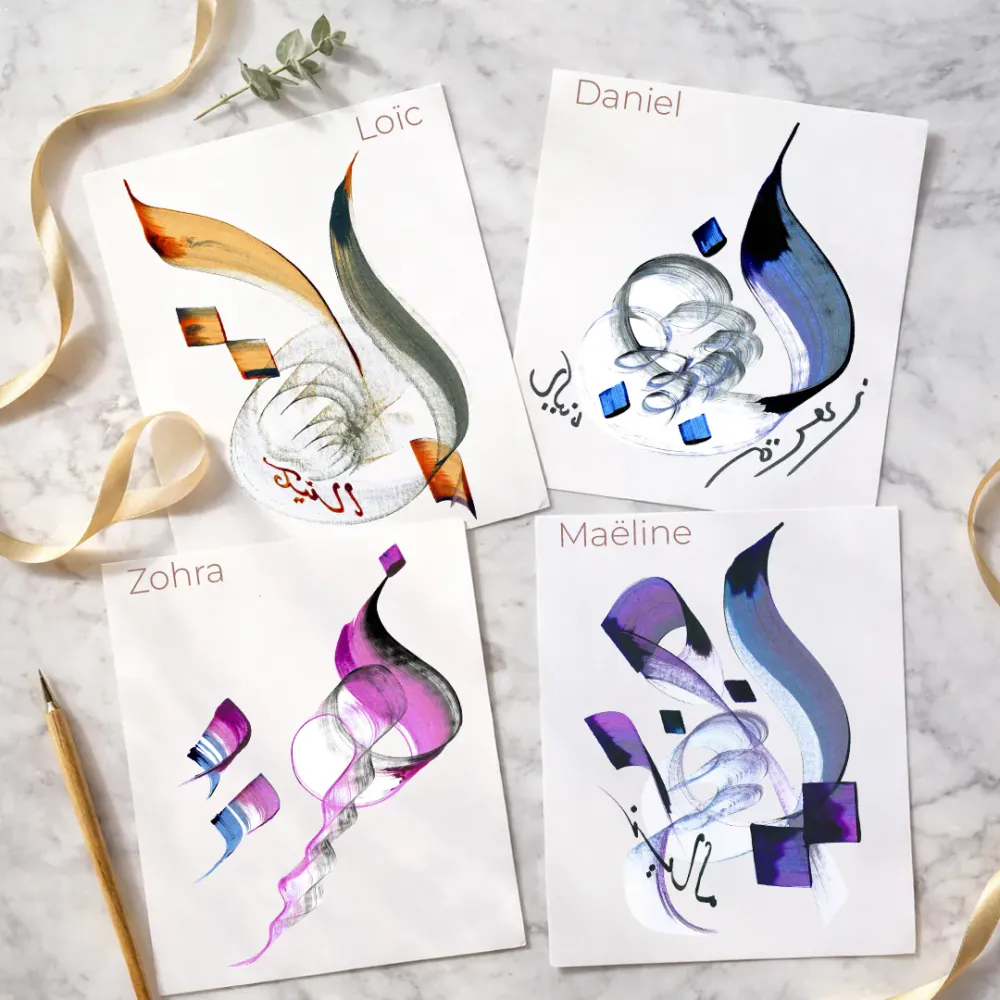
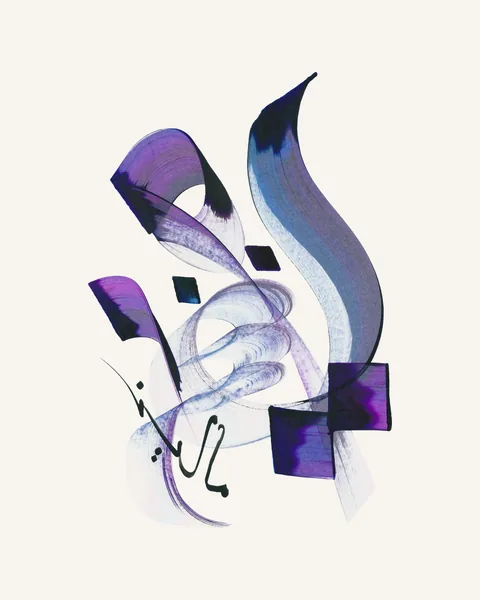
Zohra composes her names in a contemporary style, with large, free strokes. Here are three names drawn in the studio, shown as unretouched scans of the ink, with the choices she made for each one.
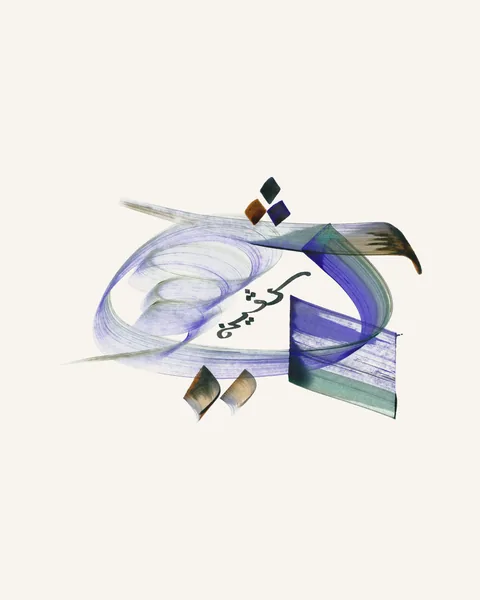
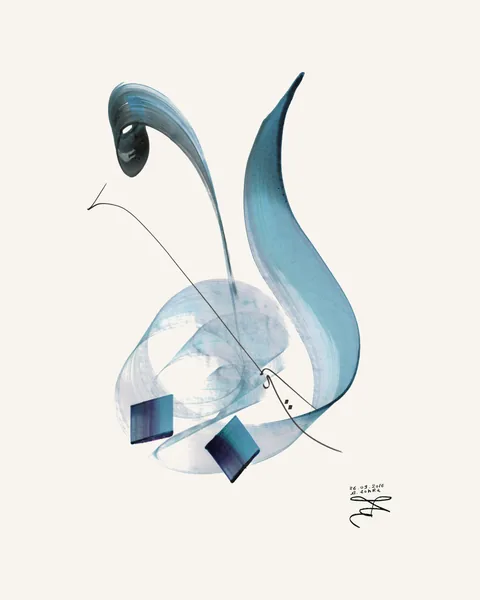
Kevin, كيڤن. Arabic has no v. Zohra writes it with ڤ, a three-dot letter added to the Arabic alphabet later on for this sound. With ف, which reads f, it would read “Kefeen”.
Maëline, مايلين. The ë becomes ي: Zohra writes “Ma-ee-leen”, with every letter included. In the composition, she also wrote the name in small letters, in everyday handwriting. Its two ي call for four dots; she put in only two, “so as not to throw the calligraphy off balance”. The small line relies on the large dots right next to it.
Louis, لوي. Here, Zohra departs from the usage found on Arabic Wikipedia. “In Arabic, it's phonetic: everything that is written is pronounced,” she explains. The s is silent in French, so she doesn't write it: “If you write the s, people will read Louiss.”
Have your name calligraphed by Zohra
Give the name in the Latin alphabet, or in Arabic if you know it. Zohra, who taught Arabic at the Algerian Cultural Center in Paris and perfected her calligraphy under the master Hassan Massoudy, adapts it phonetically, then calligraphs it by hand in the two colors of your choice, without any font at all. That is why there is no automatic preview: if your name already has an Arabic spelling or a particular pronunciation (the English or the French way, for instance), say so in the message field provided when you order.
The original, on art paper from A4 to A2, ships from the studio in France; it can also be printed on canvas, a mug or textile. Our Christmas page gives the order deadlines for the holidays.
Frequently asked questions
Can every name be written in Arabic?
Yes: every sound in French has a close Arabic letter. The result is still an adaptation, which an Arabic-speaking reader will pronounce roughly the way you do.
Does my name have a meaning in Arabic?
Usually not: transcription keeps the sound, not the meaning. By coincidence, it sometimes matches an Arabic name: Lina is written لينا, like the Arabic name, and Inès إيناس, like Inas.
Why is my name spelled differently from one site to another?
Because every step leaves a choice: the letter for p, v or g, the vowels, the silent letters, North African or Middle Eastern usage. Two different spellings can both be right.
How do you write a hyphenated first name or a surname?
Word by word. Arabic Wikipedia writes Jean-Paul Sartre جون بول سارتر, without a hyphen; you also find جان بول سارتر, closer to the French. For an official document, use the spelling on your papers.
What should you check before a tattoo or an engraving?
That the text reads from right to left, that the letters are joined, except the six that never join the next one, and that none is reversed. Have the final file checked by someone who reads Arabic.
Torn between two spellings? Write to us before you order.
Sources
- Mustafa al-Shihabi, “كتابة الأعلام الأعجمية بحروف عربية” (Writing foreign proper names in Arabic letters), Journal of the Arab Academy of Damascus, vol. 39, no. 3, July 1964, pp. 353–364 (PDF).
- Arabic Wikipedia, titles of the articles on the people cited, accessed November 4, 2026: for example Victor Hugo, Louis Pasteur, Thomas Pesquet, Kévin Gameiro and Kevin Mayer, as well as its rules for choosing article titles.
- Wikipedia, “Alphabet arabe” (in French), “Arabic alphabet”, “Arabic phonology”, “Arabic diacritics”, “Gaf” and “Ve (Arabic letter)”.
- Wikipedia, “List of people in both the Bible and the Quran”, and Arabic Wikipedia articles on the biblical and Quranic figures cited.
- Wikipedia, “Naskh”, “Thuluth”, “Diwani”, “Kufic”, “Maghrebi script” and “Kashida”.
- Unicode Consortium, The Unicode Standard, version 18.0, chapter 9, and W3C, Arabic & Persian Layout Requirements.
- Printing Impressions, article on the Arabic banners at the London Olympic Games, 2012.
- CNRTL, “Ambre” (amber), etymology.
- Google Translate test, from French into Arabic, carried out by Noun Qalam on November 4, 2026.