
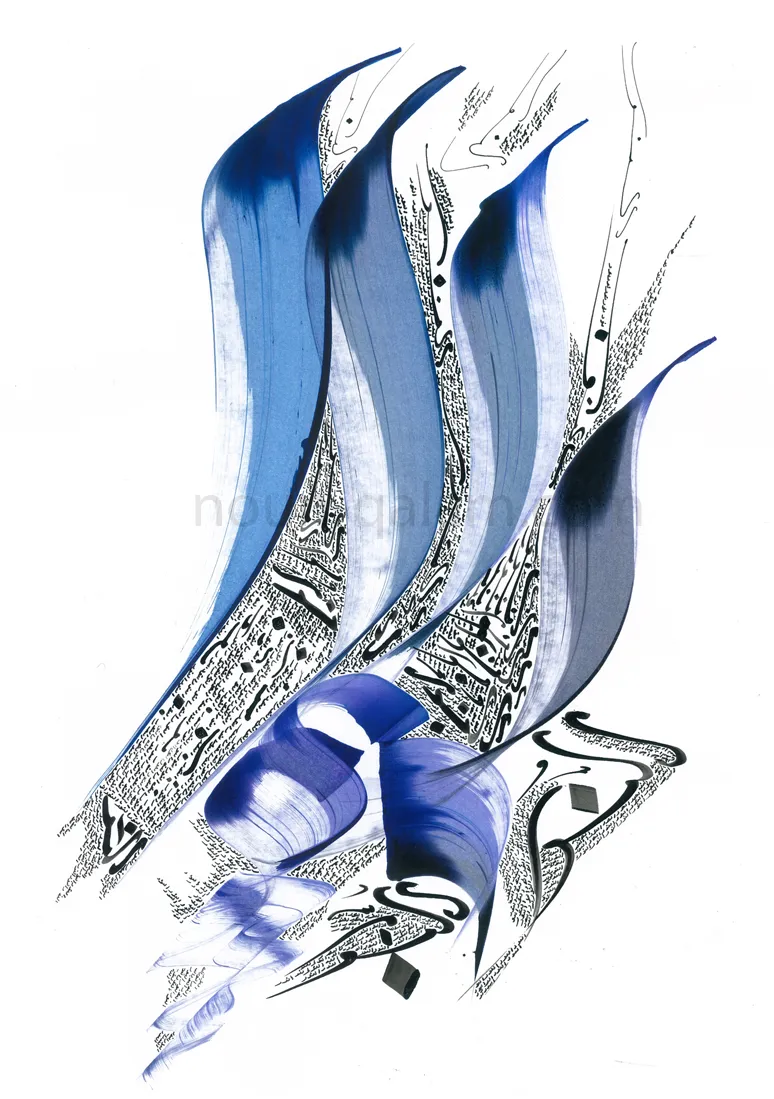
Look closely at a piece of classical Arabic calligraphy: between the great curves, small black diamonds punctuate the letters. These are dots. Their shape comes from the tool itself: a diamond whose sides depend on the width of the qalam, the calligrapher's reed pen. Their first job is to tell apart letters that look alike, but tradition also turned them into a unit of measurement.
Behind this system of proportions, tradition places one name: Ibn Muqla, calligrapher and vizier in Baghdad in the 10th century. His story mixes geometry, palace intrigue and legend. Here is what the sources say about him, and what scholars still debate.
At a glance
- Who: Abu Ali Muhammad ibn Ali, known as Ibn Muqla, Abbasid calligrapher and vizier, born in Baghdad in 885 or 886, died in prison in 940.
- His contribution: tradition credits him with proportioned script, based on the dot, the alif and a circle whose diameter is the alif, as well as with naskh.
- What is debated: whether he invented this system, and whether he took the dot as the unit of measurement. Not a single page in his hand has come down to us.
- His heirs: Ibn al-Bawwab, who died around 1022, and later Yaqut al-Musta'simi, who died in 1298, refined his legacy.
Who was Ibn Muqla?
Abu Ali Muhammad ibn Ali, known as Ibn Muqla, was born in Baghdad in 885 or 886, when the city was the capital of the Abbasid caliphate. He began his career as a tax collector. In 908, under the caliph al-Muqtadir, he was put in charge of official dispatches thanks to the vizier Ibn al-Furat.
He then rose to the very top of the administration, serving as vizier three times: in 928–930, in 932–933 and in 934–936. The Encyclopaedia Britannica sums up this career in a single sentence: three times appointed vizier, three times dismissed for meddling in political intrigue.
His contemporaries admired his hand. According to al-Tawhidi, who died in 1023, a calligrapher of his day described him as a “prophet” of calligraphy.
How does Ibn Muqla's system of proportions work?
Ibn Muqla is credited with the system known as al-khatt al-mansub, or “proportioned script.” It rests on three measures:
- the dot (nuqta), the diamond traced by the nib of the qalam;
- the alif, the upright letter, whose height serves as the reference;
- a circle whose diameter equals the height of the alif.
From the alif and this circle, every other letter can be derived. Half, a third and a sixth of the alif give the length of the straight strokes; half and a quarter of the circle give that of the curved ones. Al-Qalqashandi, who died in 1418, also credits him with a very simple test of accuracy: write three or four alifs side by side and check that the spaces between them are equal.
Finally, tradition credits him with inventing several scripts. First naskh, the first cursive style, which replaced angular Kufic as the standard script. In the 11th century, it was used both for copying the Quran and for official correspondence. Then tawqi and the more elegant thuluth. He is also credited with codifying the six classical scripts that every calligrapher must master: muhaqqaq, rayhani, thuluth, naskh, tawqi and riqa.
Is this system really Ibn Muqla's?
This account, passed down by calligraphers in the centuries that followed, now needs qualifying on several points.
The dot as a unit of measurement. In a study published in 2020 in the scientific journal PLoS ONE, the researcher Mohammad Ali Jalal Yaghan points out that Ibn Muqla did not present the dot as a unit of measurement, but as a way of distinguishing similar letters. It was later authors who measured letters in dots. The calligrapher Hassan Massoudy makes a similar point: Ibn Muqla's treatise does not mention this system of measuring in dots either, which, he suggests, was the work of other calligraphers. Other scholars argue for the opposite reading: for Ahmed Moustafa and Stefan Sperl (The Cosmic Script, 2014), it really is from the scribe's dot that Ibn Muqla derived his system.
How many dots to an alif? The early authors do not agree. The Ikhwan al-Safa, between the late 10th and the early 11th century, speak of eight units, without explicitly linking them to dots; al-Qalqashandi reports seven, or six, seven and eight depending on the calligrapher; al-Rawandi, in the 13th century, counts ten; al-Hiti, who died in 1486, nine, seven or five depending on the style. The values therefore range from five to ten.
The inventor himself. Britannica calls him the “reputed” inventor. Some sources attribute proportioned script to Ibn Muqla or to his brothers. The scholar Alain George disputes that he introduced the proportions: they may have existed before him. Sheila Blair instead links his work to a transitional script, which she calls “broken cursive,” predating the standardized style of his successor Ibn al-Bawwab.
Not a single page in his hand. No authentic work by Ibn Muqla has survived. We know him through indirect sources, such as Ibn al-Nadim. What remains are writings attributed to him, such as the Risala fi l-khatt wa-l-qalam, a treatise on writing and the qalam.
Three times vizier, three times disgraced
His letters may have been measured; his political life was anything but. During his first vizierate, in 929, a coup led by Mu'nis tried to replace the caliph al-Muqtadir with his brother al-Qahir, without lasting success. Recalled to power by al-Qahir in 932, Ibn Muqla lost it as early as 933. He then led a plot that ended, in 934, with the caliph's deposition: al-Qahir was blinded and replaced by his nephew ar-Radi.
His third vizierate came to an end in 936. The financial crisis and the failure of his campaigns, first against Mosul and then against Ibn Ra'iq, the rebel governor of Wasit, led to his dismissal and arrest. Ibn Ra'iq became the first amir al-umara, a military office that left the caliph with only symbolic authority.
The end was brutal. Ibn Ra'iq confiscated his property and his son's. Ibn Muqla plotted against him; he was found out, imprisoned, and his right hand was cut off. Later, his tongue was cut out as well. He died in prison on July 20, 940.
The biographer Ibn Khallikan records the complaint he is said to have confided to the physician treating him: he had labored in the service of the caliphs and twice transcribed the Quran, yet his hand had been cut off “as if it had been the hand of a thief.”
What follows belongs to legend, and the versions differ. According to Ibn Khallikan, he found a way to write with the stump of his arm. Other accounts say he strapped a qalam to his wrist, or that he went on writing with his left hand. No page allows us to check, since none has survived.
Who perfected his system after him?
Ibn Muqla's prestige outlived his downfall. Ibn al-Bawwab, who died in Baghdad around 1022, perfected proportioned script and refined several of the styles attributed to Ibn Muqla, including naskh and tawqi. The only Quran in his hand to have come down to us, copied in the year 391 of the Hijra (1000–1001), is held at the Chester Beatty Library in Dublin.
A famous anecdote shows how sought-after Ibn Muqla's pages were. While he was in charge of the library of the Buyid prince Baha al-Dawla in Shiraz, Ibn al-Bawwab is said to have copied out a missing section of a Quran written by Ibn Muqla, aging the pages so that they would pass for originals. The Encyclopaedia Iranica presents it as the most frequently cited example of a “benevolent” forgery in Islamic manuscripts.
In the 13th century, Yaqut al-Musta'simi, secretary to the last Abbasid caliph, refined the style inherited from Ibn Muqla still further: he replaced the straight-cut qalam with one cut at an angle, which produces a more elegant script. During the Mongol sack of Baghdad in 1258, he is said to have taken refuge in the minaret of a mosque to keep practicing. His school served as a model for Persian and Ottoman calligraphers for centuries.
Timeline: from Ibn Muqla to Yaqut
| Date | Event |
|---|---|
| 885 or 886 | Ibn Muqla is born in Baghdad |
| 908 | He is put in charge of official dispatches under the caliph al-Muqtadir |
| 928–930 | First vizierate |
| 932–933 | Second vizierate, under al-Qahir |
| 934–936 | Third vizierate, under ar-Radi |
| 936 | Dismissal and arrest; Ibn Ra'iq becomes the first amir al-umara |
| 940 | Ibn Muqla dies in prison |
| 1000–1001 | Ibn al-Bawwab copies the Quran now held at the Chester Beatty Library (year 391 of the Hijra) |
| c. 1022 | Ibn al-Bawwab dies in Baghdad |
| 1258 | Mongol sack of Baghdad; Yaqut is said to have taken refuge in a minaret |
| 1298 | Yaqut al-Musta'simi dies |
What remains of Ibn Muqla today?
More than a thousand years later, learning Arabic calligraphy still means following Ibn Muqla's code of proportions, along with other codes, regional or more subtle, as Juliette Bouveresse points out in Les clés du Moyen-Orient. She compares the calligrapher to a musician who must learn music theory before performing: perfect mastery of the rules becomes the starting point for endless improvisation on the page.
Look at the small black diamonds scattered among the large blue curves of “The Light”: these are those very dots, traced by the nib of the qalam. The piece is available as a poster from €23, on canvas from €34 and as a framed canvas from €71.
To go further, our article on the decor mistakes to avoid with Arabic calligraphy helps you choose between thuluth, naskh and Kufic to suit your home, and our guide Arabic first names: origins, meanings and calligraphic art compares the styles for writing a first name.
What about you: which letter would you like to see up close? Let us know on social media, and it might be the subject of a future article.
Sources
- Encyclopaedia Iranica, “Forgeries iv. Of Islamic manuscripts,” vol. X, fasc. 1, pp. 95–100.
- Encyclopaedia Britannica, “Ibn Muqlah” and “Naskhī script.”
- Mohammad Ali Jalal Yaghan, “Mathematical concepts in Arabic calligraphy: The proportions of the ʾAlif,” PLoS ONE, vol. 15, no. 5, 2020.
- Tammy Gaber, review of The Cosmic Script by Ahmed Moustafa and Stefan Sperl, American Journal of Islam and Society, vol. 33, no. 2, 2016.
- Juliette Bouveresse, “La calligraphie arabe, la contrainte du code et l'improvisation du geste” (Arabic calligraphy: the constraint of the code and the improvisation of the gesture), Les clés du Moyen-Orient, 2012.
- Ibn Khallikan, Biographical Dictionary, trans. de Slane, vol. III, p. 271, cited by Quintus Curtius.
- Hassan Massoudy, Calligraphie arabe vivante, Flammarion, 1998, pp. 28–29, cited by Wikipedia.
- Wikipedia, “Ibn Muqla” (French and English), “Ibn al-Bawwab” and “Yaqut al-Musta'simi.”
- Reed College, Persian Calligraphy, “Ebn Bavvāb.”
- Tareq Rajab Museum, “Calligraphers.”
- Calligraphy Qalam, “Key Master Calligraphers.”